

If you’ve noticed your child sleeping with their mouth open, breathing loudly at night, or keeping their lips parted throughout the day, it might seem like a harmless habit. But dentists and pediatric specialists increasingly agree that chronic mouth breathing can have a real, measurable impact on how a child’s face and jaw develop. Left unaddressed, it can shape everything from tooth alignment to the overall structure of the face.
This blog breaks down the science behind mouth breathing, the visible signs parents should watch for, and what can be done to correct it before it affects your child’s long-term facial growth and dental health.
Why Does Nasal Breathing Matter So Much?
Humans are designed to breathe primarily through the nose. Nasal breathing filters, warms, and humidifies the air before it reaches the lungs, and it also plays a quiet but crucial role in how the jaw and facial bones develop during childhood.
When a child breathes through their mouth instead — whether due to blocked nasal passages, enlarged tonsils or adenoids, allergies, or simple habit — the tongue no longer rests in its natural position against the roof of the mouth. This resting tongue posture is actually what helps guide the upper jaw to grow wide and forward. Without it, the jaw can develop narrower and longer than it should, setting off a chain reaction that affects the entire face.
How Mouth Breathing Affects Facial Growth
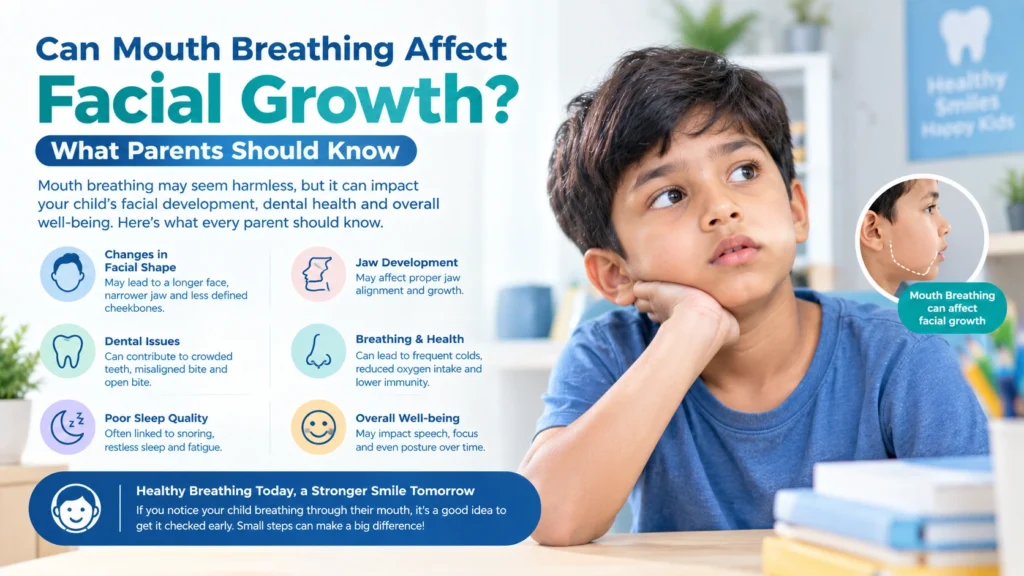
Pediatric researchers often refer to this pattern as “long face syndrome” or adenoid facies. Some of the most common facial and dental changes linked to chronic mouth breathing include:
- Narrow upper jaw – Without the tongue pressing upward, the palate fails to widen properly, leading to a high, narrow roof of the mouth.
- Elongated facial appearance – The lower jaw tends to rotate downward and backward, giving the face a longer, flatter look.
- Crowded or crooked teeth – A narrow jaw often doesn’t have enough room for all the permanent teeth to come in straight.
- Open bite or overbite – Improper tongue posture and jaw growth can prevent the front teeth from meeting correctly.
- Weak chin development – The lower jaw may appear less prominent compared to children who breathe normally through the nose.
- Dark circles and tired-looking eyes – Poor sleep quality from restricted airflow is a common side effect.
These changes don’t happen overnight — they develop gradually over months and years, which is exactly why early detection matters so much.
Signs Your Child May Be a Chronic Mouth Breather
Many parents don’t realize their child is a habitual mouth breather until a dentist points it out during a routine visit. Watch for these signs:
- Sleeping with the mouth open, often with visible drooling on the pillow
- Snoring or noisy breathing during sleep
- Dry lips or a dry mouth upon waking
- Dark circles under the eyes
- Frequent morning headaches or irritability from poor sleep
- Bad breath despite good brushing habits
- A tendency to breathe through the mouth even while awake and resting
If several of these signs sound familiar, it’s worth scheduling an evaluation with a Pediatric Dentist in Pune who can assess airway health alongside dental development, since the two are far more connected than most parents realize.
What Causes Mouth Breathing in Children?
Understanding the root cause is essential to correcting the habit rather than just managing the symptoms. Common causes include:
- Enlarged tonsils or adenoids – These can physically block the nasal airway, forcing the child to breathe through the mouth.
- Chronic allergies or sinus congestion – Ongoing nasal inflammation makes nasal breathing uncomfortable or difficult.
- Deviated septum – A structural issue that restricts airflow through one or both nostrils.
- Habitual patterns – Sometimes the habit persists even after the original physical cause has been treated, simply because the muscles never relearned the correct resting posture.
A thorough evaluation — sometimes involving both an ENT specialist and a dentist — helps pinpoint exactly what’s driving the habit.
How Is Mouth Breathing Diagnosed and Treated?
Diagnosis typically starts with a simple clinical examination. A dentist will look at the shape of the palate, the position of the tongue at rest, the child’s bite, and signs of facial asymmetry. In many cases, parents are also asked about sleep patterns, snoring, and daytime fatigue, since these all provide important clues.
Treatment approaches depend on the underlying cause and may include:
- Referral to an ENT specialist to address enlarged tonsils, adenoids, or chronic congestion
- Myofunctional therapy – targeted exercises that retrain the tongue and facial muscles to rest correctly
- Palatal expanders – dental appliances that gently widen a narrow upper jaw, creating more room for the tongue and improving airflow
- Early orthodontic intervention – guiding jaw growth in the right direction before permanent teeth fully erupt
The earlier these issues are identified, generally before age 8-10, the more effectively the jaw can be guided back toward normal growth patterns, since the bones are still developing and more responsive to gentle correction.
Why Early Intervention Makes a Difference
Many parents assume dental visits are only necessary once a child has cavities or crooked teeth, but airway and breathing evaluations are just as important, especially during the growth years. A child’s facial bones are far more moldable before puberty, which means correcting a mouth-breathing habit early can prevent years of more complicated orthodontic treatment later on.
At Soulful Dental Care, evaluations go beyond simply checking for cavities. The team looks holistically at airway health, tongue posture, and jaw development as part of every pediatric visit, catching potential issues long before they become visibly obvious.
Meet Dr. Swapnil Rachha
Parents across the city trust Dr. Swapnil Rachha for a thoughtful, whole-child approach to pediatric dental care. Rather than treating symptoms in isolation, Dr. Rachha takes the time to understand contributing factors like breathing patterns, sleep quality, and habits — because these often explain issues that a routine dental exam alone might miss. This comprehensive approach has made the practice a trusted choice for families searching for a reliable Dentist in Kothrud who understands the connection between breathing, growth, and long-term oral health.
Why Parents Choose Soulful Dental Care
Families looking for the Best Dental Clinic in Kothrud often mention the same thing: a team that listens carefully and explains things clearly before recommending treatment. Rather than jumping straight to appliances or referrals, the clinic takes a measured, evidence-based approach tailored to each child.
For those comparing options and searching for the Best Dentists Near Me in Kothrud, Pune, the clinic stands out for combining general pediatric dentistry with specialized knowledge of airway and orthodontic issues — meaning your child can be assessed and treated without being bounced between multiple providers.
Parents searching specifically for a Pediatric Dentist Near Me also appreciate the calm, child-friendly environment, which makes even sensitive evaluations, like checking tongue posture or airway concerns, far less intimidating for younger patients.
What Sets a Great Pediatric Practice Apart
When researching the Best Pediatric Dentist in Pune, parents should look beyond just cavity checkups. A truly comprehensive practice considers:
- Facial growth and jaw development patterns
- Breathing and sleep quality assessments
- Early orthodontic screening
- Clear, judgment-free communication with parents
Many families comparing clinics online for the Best Pediatric Dentist doctors Near Me in Pune find that this broader, growth-focused approach leads to better long-term outcomes than treatment plans that only address visible dental problems. And for parents seeking an all-around trusted provider, this clinic is frequently recommended as the Best Dentist in Pune for families who want one team managing both dental and developmental concerns as their child grows.
Frequently Asked Questions (FAQs)
Q1. How do I know if my child is a mouth breather or just breathing normally during sleep?
Occasional open-mouth breathing during a cold is normal, but if it happens consistently, along with snoring, dry lips, or dark circles, it’s worth having it evaluated.
Q2. Can mouth breathing really change my child’s face shape?
Yes. Chronic mouth breathing affects jaw and tongue posture over time, which can lead to a narrower palate, longer facial profile, and dental crowding if left untreated.
Q3. At what age should I get my child evaluated for mouth breathing?
The earlier, the better. Most specialists recommend evaluation as soon as symptoms appear, ideally before age 8, when the jaw is still highly responsive to correction.
Q4. Is mouth breathing only caused by nasal blockages?
Not always. While enlarged tonsils, adenoids, and allergies are common causes, habitual patterns can persist even after the original blockage is resolved.
Q5. Will my child need braces because of mouth breathing?
Not necessarily, but early correction of the breathing habit can reduce the severity of future orthodontic needs and sometimes prevent them altogether.
Q6. Can this be fixed without surgery?
In many cases, yes. Myofunctional therapy, palatal expanders, and addressing allergies or congestion can resolve the issue without surgical intervention. An ENT referral is only needed for structural blockages.
Give Your Child the Best Start for Healthy Growth
Mouth breathing might seem like a small habit, but its effects on facial and dental development can last a lifetime if left unchecked. The good news is that with early evaluation and the right treatment plan, most cases can be corrected effectively, helping your child breathe, sleep, and grow the way nature intended.
Book a comprehensive dental and airway evaluation for your child today, and give them the healthiest possible foundation for growth.